How Does the Art of Lotus Significant to India
In the vast repertoire of Indian ornamental motifs, among the symbols and devices that recur in traditional art and compages, the lotus occupies pride of place. Unlike western art, in which great emphasis is laid on photographic realism and the naturalistic handling of human and creature forms, the main concerns in Indian fine art are greatly spiritual and religious. Each and every object portrayed in Indian art has a religio-spiritual and symbolic significance.
Amongst the flowers, the lotus is the almost preferred symbol, not because of its beautiful form, but because of its profound symbolism. We all know that this flower grows in muddy waters, but remains unaffected past it. Whether white, bluish (nilotpala), rose pinkish or white and pink, its petals evoke the sentiments of purity in everybody's mind. Co-ordinate to Hindu philosophy, human beings ought to live like a lotus flower in this wily, unscrupulous world, completely detached and pure hearted, untouched past evil forces.
Ascent from the depths of water and expanding its petals and leaves on the surface, through its appearance, it gives proof of the life-supporting power of the all nourishing completeness. This is the reason why a lotus flower
in total bloom is used as the pedestal or throne back up of all the deities — Hindu, Buddhist and Jain.

Vishnu and Lakshmi Standing on a Lotus Protected by Sheshnag
Invariably, they are shown seated or continuing on a fully open lotus flower (padmu pitha) or on a double petalled
lotus (mahambuja). This has symbolic connotations: the deities are represented in their transcendental, subtle forms, i.e. the spiritual trunk which is weightless. If seated with ane leg dangling downwards, so likewise the deity's foot rests upon the lotus pedestal or absorber.
Numerous Hindu deities are shown holding a lotus flower, for case, Vishnu who preserves the universe, is invariably holding the padmu (lotus) in one of his four easily. Vishnu's spouse Lakshmi, the goddess of wealth, Shiva's consort Parvati, Surya the Sun god, the Bodhisattva Padmapani — all these deities hold a lotus flower in their easily. In fact, even the personified sacred river goddesses Ganga and Yamuna e'er hold a long stemmed lotus, characterized past a long stalk, the undulations of which match the contours of their elegantly standing 'S'-shaped bodies.

Wooden Lantern ceiling relived with lotus flowers and an immense lotus rosette in the centre, from the Mandapa ceiling of Chamunda Devi temple, Chamba (Himachal Pradesh), 17th century CE.
In Indian paintings, whether miniature ones or frescoes, the flowing waters of the river or a pond are always indicated past lotus bloom and their broad leaves floating on their surfaces. This tradition has persisted from aboriginal times. In the world renowned Ajanta caves frescoes, the lotus pond is an alluring function of the landscape, and continued to be and so in subsequent centuries till the dawn of 20th century.
All the schools of miniature painting that flourished in the royal courts all over Republic of india, more especially in Rajasthan and western Himalayas – the latter popularly known as the Pahari Schoolhouse – feature the river front end as well as lotus pond in this style. Lord Krishna and his exploits (lila) were the most popular themes painted with great verve on business relationship of his romantic escapades. In Pahari miniature schools, not only Krishna but all the Hindu deities are featured as sporting pinnacled crowns surmounted by lotus buds.
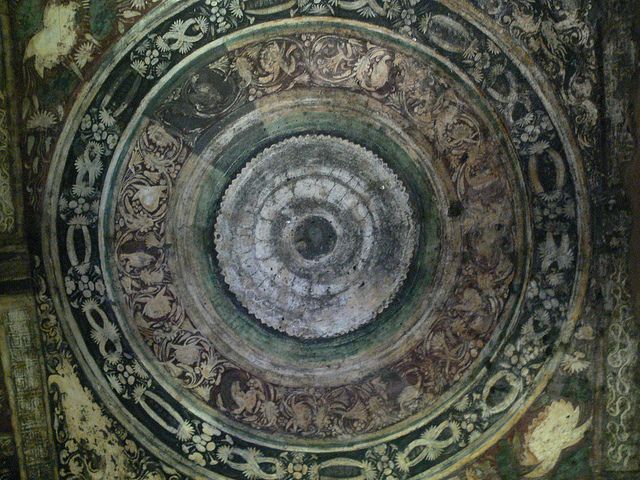
Painted ceiling from a Cave Temple at Ajanta enclosing lotus flowers within concentric rings of circular mandala, 5th Century CE.
From the period of Ajanta frescoes (2nd century BCE to approximately 7th century CE) onwards, the ceilings are painted with concentric circles enclosing a variety of motifs, the lotus flowers, buds and petals have been painted in heed baffling variety; each one is different from the other, far more than frail and impressive.
The tradition of chiselling a large lotus rosette in total bloom carved in assuming relief, with wide petals, spread out or at times crimper in with swell effeminateness and finesse, is also very aboriginal. Such ceilings accept survived in the rock—cutting cave shrines at Ellora, in the 7th century CE timber and monolithic temples in Himachal Pradesh, in Bharmaur and Chhatrarhi in Chamba, at Masrur in Kangra district.
This tradition was not, still, confined to these regions lonely, just existed all over India. The key component of the mandapa ceiling in the famed marble Jain temple at Mount Abu in Rajasthan, erected by Vimala Shah in the 11th century CE is a great masterpiece of artistic talent and ingenuity displayed by the local sculptors who produced an exquisitely carved pendulous, grid-like lotus rosette, that haunts one long later on one's visit to these marvellous shrines. This tradition persisted all through the centuries down the ages. Diverse architectural components in the stone temples have been relieved with lotus rosettes in a variety of ways.
In both the timber and lithic temples, near all over India, lotus rosettes apart, there are bands of exquisitely carved lotus petals running through the external and interior walls, as also ceilings, separating panels relieved with diverse episodes from the legends pertaining to the deities. The doors display an immense lotus rosette chiselled all over their surfaces. The undulating lotus volutes likewise as broad lotus petals contribute to the rich upshot of the door frames, the stone and brass uprights of the flaming, effulgent aureoles (prabhavalis) surrounding the icons of worship installed in the inner sanctums of the temples.
The heads of all the deities are also surrounded by a circular halo relieved with 8 lotus petals, the numeral eight having a mystical connotation and significance. The undulating, meandering creepers formed past the long fatigued out lotus stalk lend elegance and delicacy to many a temple doorway from Kashmir in the north to tip of south India, from Gujarat in east to Orissa in the westward.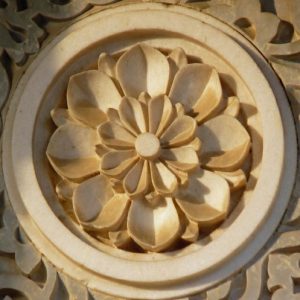
The tradition of carving immense lotus medallions of roundels enclosing bird and animal motifs harks back to the pre-Christian era when the famous Buddhist stupas were erected at Bharhut and Sanchi. This tradition is not confined to religious architecture alone. Information technology enriches the residential houses of the ordinary natives as well, apart from their delineation on the walls of the royal palaces and forts.
When the Muslim and Mughal rulers got their palaces erected, the native craftsmen continued to employ the aforementioned motifs to peachy advantage. In the twin Carmine Forts of Agra and Delhi, large lotus rosettes made of marble are embedded on the floors, from the centre of which the fountains spouted forth water to keep the palaces cool during the hot, sultry summers of north India.
This motif was non confined to architecture, religious or non—religious, lone; it was profusely used in all forms of crafts. Most embroidered fabrics feature the lotus mandalas in the heart, effectually which are sprinkled numerous motifs and figures.
In woven and printed textiles as well, in stone and forest carvings, in ornaments worn by women, the lotus rosettes are used with immense innovativeness and imagination. The multi-petalled lotus rosette offered the craftsmen working in all mediums plenty of scope to display their astonishing talent, skill and ingenuity. This motif is found ubiquitously in its many splendoured course in all forms of crafts all over India.
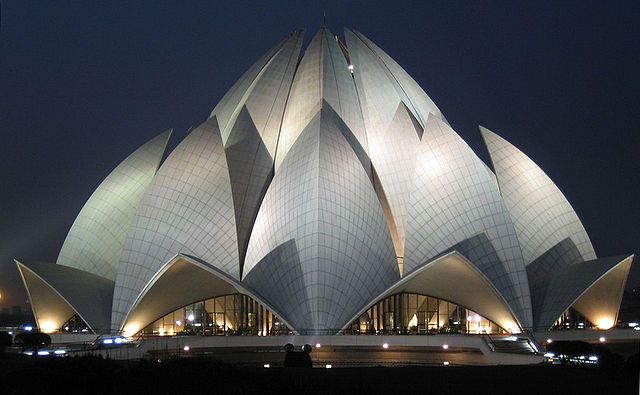
The Lotus Temple, located in New Delhi, India
Source: https://www.themysteriousindia.net/the-lotus-in-indian-art/
0 Response to "How Does the Art of Lotus Significant to India"
Post a Comment