How the Drug Addict Mom Effecy the Baby in the Womb
Editor's Notation: This is part 2 of a iii-part series from our partners at Reuters.
This story, fix in Charleston, W Virginia, has a chance of catastrophe happily. But it begins last fall in a mangy downtown apartment equally Katy Yeager, seven months pregnant, stares at a syringe and the crumpled foil that holds $40 worth of heroin.
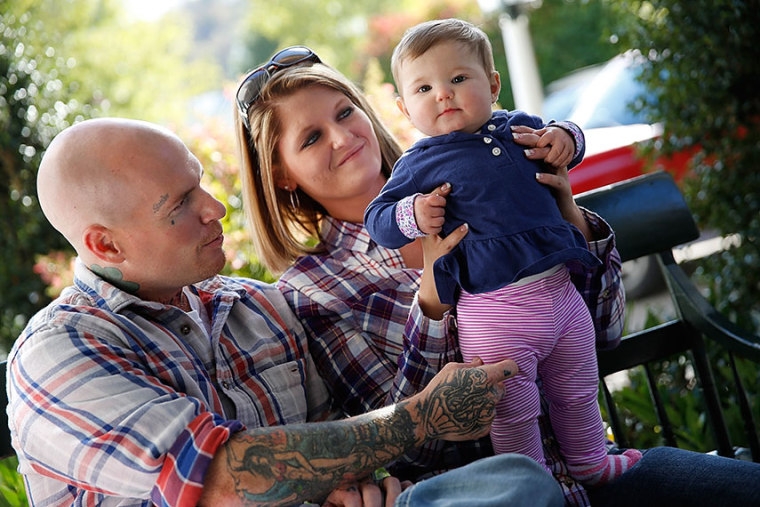
Yeager, 24, had been make clean since leaving jail eight months before. Initially, she was elated to be significant. But then the baby'southward father, a former coal miner she'd met in rehab, was sent back to prison house. She faced raising the baby solitary.
Her terminal trimester was filled with indisposition, nausea and anxiety. She hated the job required by her probation — eight hours a twenty-four hour period on her feet as a waitress at a Shoney's eatery. And she was drastic for coin to buy a crib and diapers.
"I just wanted to escape from myself," Yeager recalled, "basically the loneliness, the anger and dubiety of everything."
Getting high is like shooting fish in a barrel in Charleston, a city at the eye of Appalachia's epidemic of opioid addiction. On that autumn mean solar day last year, two months before her infant was due, Yeager poured powdered heroin into a spoon, added water and held a lighter beneath it until the drug liquefied. She filled the syringe and found a vein on the palm of her manus. In seconds, all her worries vanished.
Click Here to Read the Reuters Serial on Drugs and Newborns
After most a week, Yeager decided to stop using. But this "slip up," every bit she describes it, presented a dilemma: 2 friends who quit common cold turkey had gone into premature labor. With heroin nevertheless in their bodies, the state seized their babies. Fearing this, she obtained a legal prescription for Subutex, a drug used to treat opiate addiction.
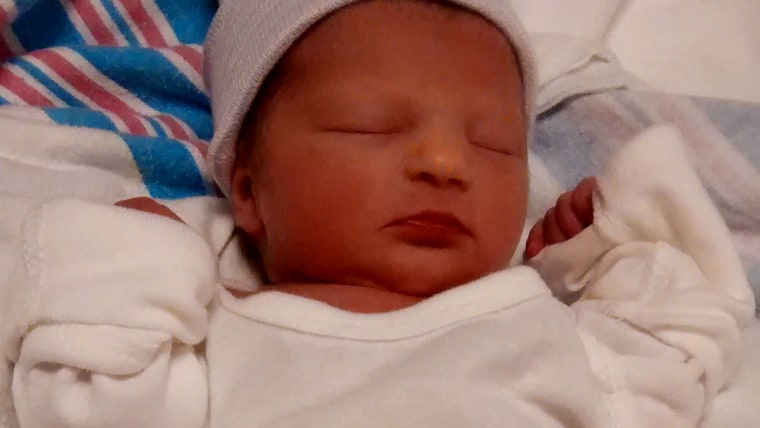
In mid-December 2014, Yeager went into premature labor anyway. Her babe, Kennedy Jade Yeager, faced a harrowing first few months. Born hooked on the drugs her mother had been taking, Kennedy began an aching withdrawal.
Federal law requires states to have plans to identify and protect babies like Kennedy, not but during their hospital stays but after they are sent home with their mothers. Near states fail to comply, Reuters found, leaving at take chances thousands of children built-in drug-dependent each year.
West Virginia is an exception. Forth with the District of Columbia, it'southward ane of no more than 9 states that insist doctors report every instance to child protection workers— non necessarily to remove babies, officials say, but to keep them rubber while helping their mothers.
A memo issued early on last twelvemonth past the state's Department of Health and Human Services explains why each case must be monitored. It refers to a "rash" of child fatalities involving babies whose mothers had been using drugs that were legally prescribed to them. The memo tells social service and kid welfare workers that "information technology is oftentimes impossible to know" whether a female parent is "actively involved in a treatment plan or if the parent is abusing the prescribed drugs … and unable to properly care for a newborn."
That's why the state says it wants to appraise all cases in which a child tests positive for drugs.
"All newborns are extremely vulnerable," the memo says, "as 100 percent of their livelihood is dependent upon their caregivers."
It's that reality that inspired a charity in nearby Huntington to create a program designed to do more than simply wean newborns off drugs. Health care and social workers besides train mothers fighting their own addictions to care for the difficult babies. Experts say simply a handful of similar programs exist nationwide.
At the hospital, Yeager was among the first to be offered entry into West Virginia's pilot program, which began in October 2014. To enroll, she had to sign Kennedy over to land custody. If both baby and mother successfully completed the program, the social worker promised, Yeager would get Kennedy back.
'A Crunch Right Hither'
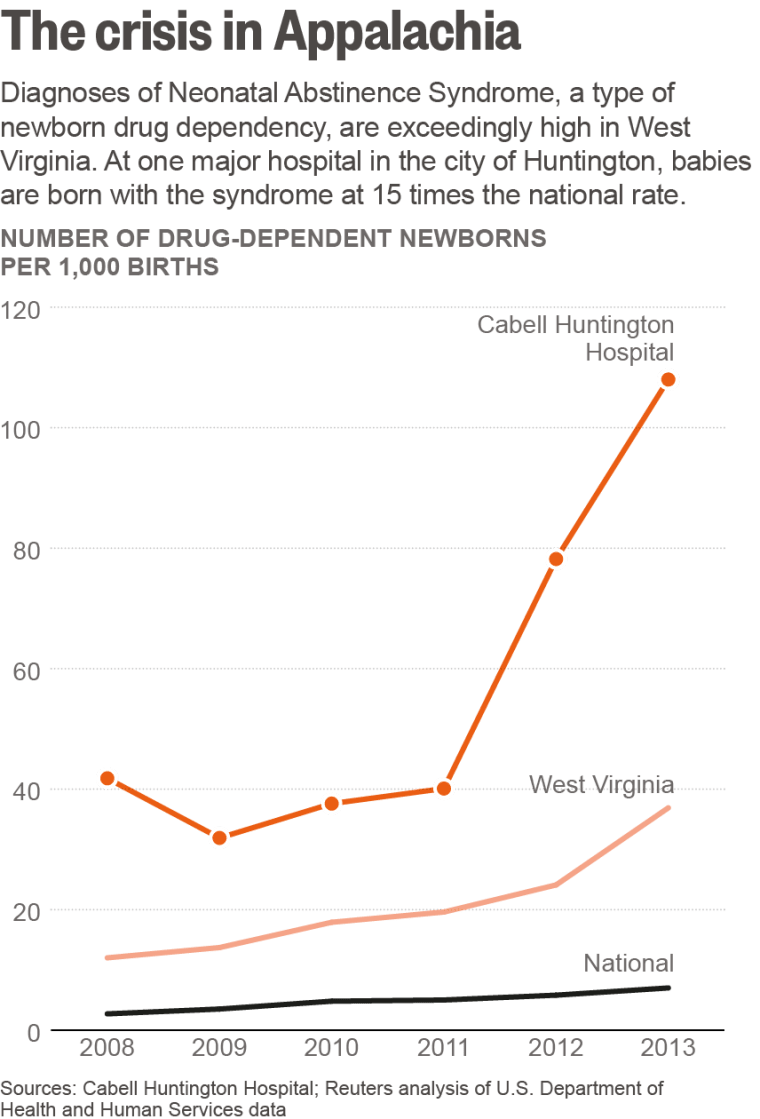
Nationally, nearly seven out of every one,000 babies born in 2013 were diagnosed with Neonatal Forbearance Syndrome, a consequence of drug dependence among newborns, according to a Reuters analysis of federal data.
In West Virginia, the charge per unit is about five times higher — 37 of every 1,000 babies. At Cabell Huntington Hospital, where Kennedy was born, 108 of every i,000 babies born in 2013 were diagnosed with Neonatal Forbearance Syndrome. Last year, the rate at Cabell Huntington increased to 139 out of 1,000.
The pace hasn't slowed this yr, nurses said. In one 24-hour period last month, half dozen babies were born in drug withdrawal. On average, the hospital handles eight births a 24-hour interval, which includes both healthy and sick infants.
"Even in your darkest, deepest imagination, you tin can't imagine their agony," said neonatal nurse Sara Murray. "You lot think you might know what one of these tremoring and screaming babies sounds and looks like, but it'due south nada like a colicky baby. We have some who scream equally if their limbs are being ripped off."
The trouble first became astute at Cabell Huntington in 2011, doctors said. By then, newborns withdrawing from drugs occupied two-thirds of the neonatal intensive care unit, which has 36 beds. That left little room for newborns with life-threatening conditions unrelated to a mother's drug use.
"We are the large regional infirmary in a 3-hour radius, and nosotros were turning down ill and needy babies from other hospitals," said Sean Loudin, the neonatologist who treated Kennedy.
In 2012, the hospital created a 2d neonatal unit just for babies going through withdrawal. Those 16 spots soon filled, besides.
The kernel of a solution came when two veteran neonatal nurses, Murray and Rhonda Edmunds, explained to a infirmary volunteer that the babies would heal faster if they lived off-site, somewhere far from buzzing machines and bright lights, and where mothers could learn parenting skills. The volunteer, local activist Mary Calhoun Chocolate-brown, got to work.
"Lots of friends at church go on overseas missions, and no disrespect to them, but we have a crunch correct here at dwelling," Chocolate-brown said. Her offset call was to Evan Jenkins, so a state senator and now a U.S. Congressman.
The nurses developed a medical plan. Jenkins devised ways to navigate state, Medicaid and insurance bureaucracies. Chocolate-brown founded a charity to manage the facility and raised startup funds from coal industry foundations. A podiatrist'south widow donated her husband's vacant role building.
Lily's Place opened last fall with a mission to treat newborns and mothers in a nonjudgmental fashion. Presently, babies began arriving.
Difficult Times, Hard Choices
Yeager knew the dangers opiates pose. At least five high school friends had overdosed and died. Two women she knew had been jailed presently after giving nativity, i for accidentally smothering and killing her child while in a drugged shock.
Yeager also understood how difficult motherhood tin be. 7 years earlier, while in high school, she'd given birth to a girl. Yeager said she did not go high during that pregnancy, merely when her child was a toddler, she began abusing prescription painkillers. Yeager became homeless and transferred guardianship of the child to the begetter's parents.
She didn't want to lose another baby.
She was already on probation for a law-breaking: Stoned on Xanax and methamphetamine in March 2012, Yeager had helped two men rob an elderly homo of $200. Constabulary caught the iii hapless addicts hours later.
Yeager pleaded guilty and was sentenced to 2 years' probation in jump 2013. Within months she tested positive for morphine and marijuana, skipped probation meetings and fled to Ohio. She was arrested in late 2013 and jailed until early 2014, when she began rehab and went to alive in the flat for female person addicts in Charleston.
RELATED: Hooked: A teacher'due south addiction and the new face of heroin
During recovery sessions nearby, she met Donnie Gooding, a onetime coal miner who had just served a short jail term for manufacturing meth. He was ix years older and cocksure. She loved his tattoos— he had the discussion LUNATIC stenciled beyond his cervix — and the passion with which he pursued her. Before long, she became pregnant. For a while the couple dreamed of a sober futurity with a salubrious baby.
Simply by late summer 2014, Gooding violated probation and was sent dorsum to prison. That'due south when Yeager relapsed then started on Subutex.
A brusque while afterwards, during her eighth month of pregnancy, Yeager decided to visit her grandparents in Barboursville, about an hour abroad. Their business firm happened to be a few miles from Cabell Huntington Infirmary and Lily's Place.
Four Pounds, 6 Ounces
Yeager went into labor during the visit, and her grandfather rushed her to Cabell Huntington. Kennedy was born there on Dec. 19, 2014, iv weeks premature.
She weighed just 4 pounds, 6 ounces. On a chart, a nurse rated Kennedy more often than not salubrious but noted that she seemed hyperactive and jittery, the kickoff hints of withdrawal.
Most half of the babies born to mothers who accept opiates during pregnancy begin life the way Kennedy did. While she was in the womb, Kennedy's brain had been stimulated by drugs for months. Just at nativity, when the umbilical cord was cut, the opiate supply suddenly stopped, creating a chemical imbalance and abnormal behavior.
Babies like Kennedy arrive in the earth irritable and hyperactive, making them far more difficult to go on calm than typical newborns. The tiniest noises tin can trigger inconsolable wailing. They are frightened hands, ofttimes by their own movements, even extending a leg. They can suffer involuntarily spasms and fits of yawning and sneezing.
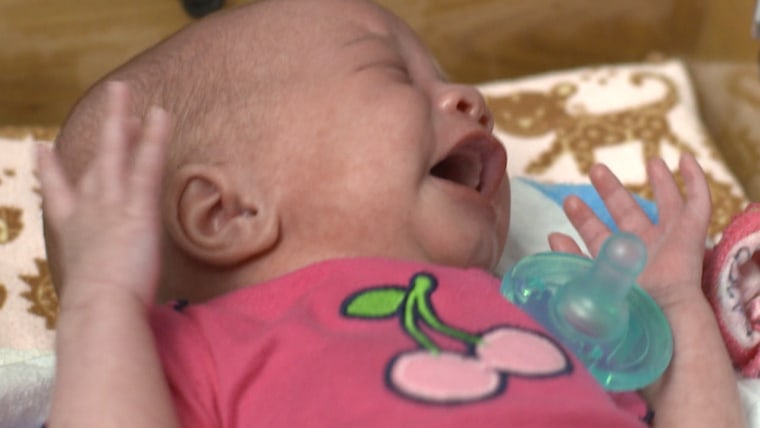
Feeding can be a struggle. Unable to focus, the babies often choke or coughing later a few sips of formula or breast milk. The sensation tin can panic them. Kennedy, typical of newborns in withdrawal, suffered from explosive diarrhea. Painful rashes followed.
Two days afterward birth, Kennedy was transferred to Cabell Huntington'south special neonatal unit for babies in withdrawal. Yeager was discharged.
"It didn't actually hit me until I got home and she wasn't with me," Yeager recalled. "Then I had all the guilt and regret. I'yard a terrible mother. Why would I practice this?"
RELATED: Clandestine life of teens: The dangerous drug parents aren't talking about with kids
Kennedy began a withdrawal protocol — decreasing micro-doses of methadone, a heroin-replacement drug —that lasted five weeks. When Yeager visited the infirmary, she found it hard to keep Kennedy calm, in part considering the infant shared a room with two other wailing, drug-dependent babies.
A few days afterward, Yeager was approached past Angela Davis, a Lily'due south Place social worker. Davis invited her to put the baby in the new facility. "She explained that it was just like a hospital merely Kennedy would become her own room," Yeager recalled.
The offer included requirements for mother as well: Yeager would accept to visit Kennedy six times a week, help the nurses care for her babe, take parenting classes, run across regularly with the social worker, and attend her own habit recovery sessions. Most important, she needed to learn her newborn's "stress cues" and how to address them. Yeager promised to do everything.
"Practice Not Corruption Your Baby"
Kennedy'south condition was charted with a widely used medical calibration to tally the frequency, length and severity of symptoms— high-pitched cries, tremors, sweating, poor sleep. A score of eight or higher means a infant's condition is considered severe.
After two weeks at the hospital, Kennedy was transferred to Lily's Place. On her first solar day at that place, her average score was 7. Within days, her score climbed to x. At times it hit 17. Kennedy continued to sweat and weep excessively. Every few days, she shook with tremors.
Kennedy's boilerplate score did non drop below viii until her third week at Lily'south Place. Although dotors took the baby off methadone, they warned Yeager that Kennedy's withdrawal would continue for months.
On Kennedy's terminal day at Lily's Place—she was 5 weeks old— Yeager was shown a video prepared by Loudin, the neonatologist.
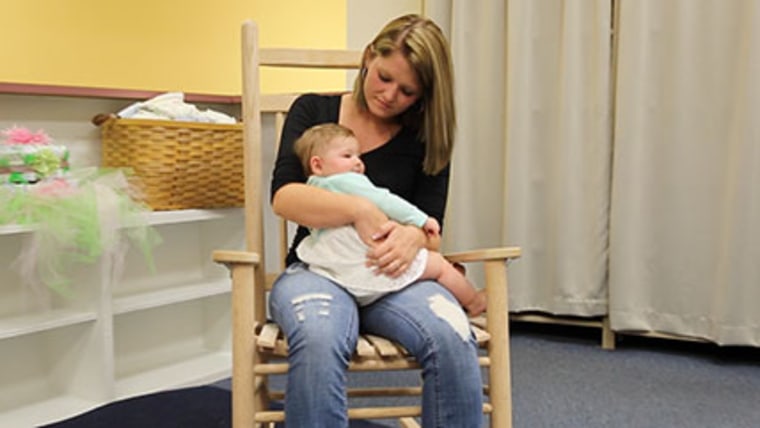
"You lot are non taking home a completely normal newborn babe," the doctor said in the video. "You have to recognize your baby is going to have bad days. At these times it is vital for you to keep yourself calm and not do anything that tin can impairment the baby. Delight, if you observe yourself frustrated, the safest thing you can do is put your baby in a car seat, put it on the flooring and walk away for a few minutes and collect yourself. Do non milk shake your baby. Do non abuse your infant."
A Fresh Outset
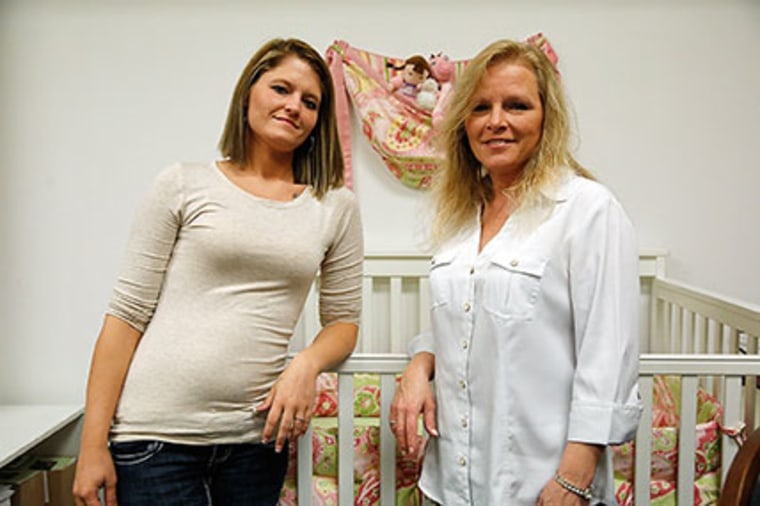
For Yeager, her grandparents' domicile in Barboursville, a village near Huntington, had long been a refuge. She spent years growing up at that place and was welcomed back in her early 20s, even later she repeatedly stole from them and a boyfriend once assaulted her granddaddy.
The grandparents agreed to drive Yeager to recovery meetings and pediatrician appointments. But they insisted that Yeager would have to treat Kennedy 99 percent of the time.
During the get-go few weeks at their dwelling, Kennedy's tremors connected. Often, she was cranky. Yeager said she did her best to at-home Kennedy, applying tips from Lily'south Place, such as swaddling the infant snugly and darkening the room.
"It was stressful … I'd be lying if I said I didn't think about getting high," she said. "But then I realized how far I had come and where I wanted to go, and that if I did that, Kennedy could exist sent to a foster home, and anything could happen to her there."
Yeager's own recovery appeared to accelerate belatedly this summer, afterward Gooding was released from prison. They married, and she began taking higher courses online. Gooding got a steady construction task and helped Yeager pay off fines then she could go a learner's permit to drive.
RELATED: Hip2Save's Collin Morgan reveals how coupons saved her life from habit
Recently, the couple rented a tiny apartment near Yeager'south grandparents. She takes a prescription drug to help her resist her heroin cravings. Both say they are off illegal drugs. In September, Yeager took Gooding'south final proper noun. In October, their baby did, as well.
Since Lily's Place opened late terminal yr, 66 babies have been weaned off drugs in that location. The fates of their mothers vary. Social worker Davis estimated that 80 pct were doing well on the twenty-four hours their baby was discharged; they were either off drugs completely or in recovery as part of a md-ordered prescription protocol. Two take overdosed and died.
But all 66 babies are alive.
This fall, Kennedy hit milestones for normal infants of her historic period: Past viii months, she could sit down upward, crawl and hold things in her hands. Her weight climbed to 19 pounds. She started pulling herself upright while balancing on the side of a burrow or chair, a precursor to her start steps. And she began to smile in elevators and restaurants, no longer frightened by noise and bright calorie-free.
How the Drug Addict Mom Effecy the Baby in the Womb
Source: https://www.today.com/health/new-help-babies-withdrawal-moms-battling-addiction-t60191
0 Response to "How the Drug Addict Mom Effecy the Baby in the Womb"
Post a Comment